
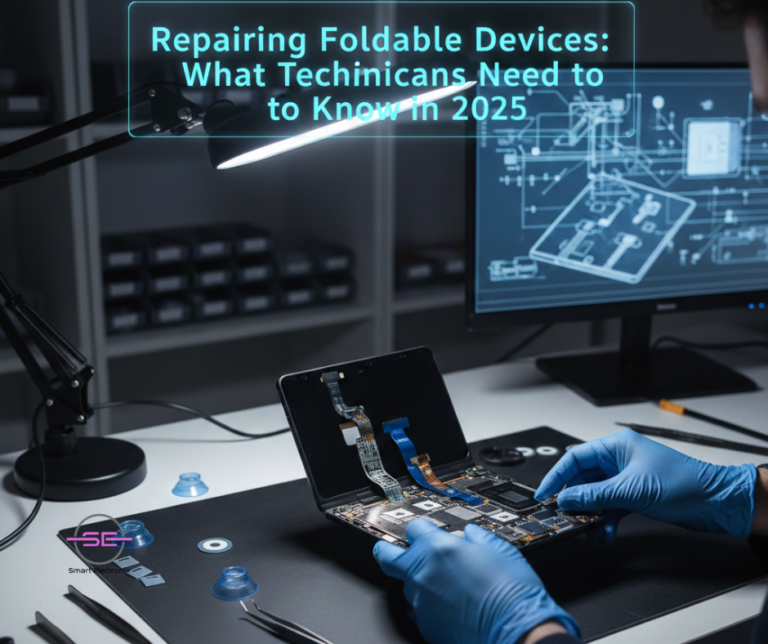
Foldable smartphones and tablets are no longer niche gadgets — they’re quickly becoming mainstream in Australia. Samsung, OPPO, Motorola, and Google have pushed foldable technology into the hands of everyday consumers. As adoption grows, so does the demand for expert foldable device repairs, something many technicians are still adapting to.
Repairing foldables in 2025 is drastically different from repairing traditional flat-screen phones. These devices include ultra-thin glass, flexible OLED panels, complex hinge assemblies, and layered component stacks that require advanced techniques and specialised tools.
In this detailed guide, Smart Electronix breaks down everything technicians need to know when working with foldable devices in 2025 — the challenges, the tools, the skills, and the safety considerations.
1. Foldable Devices Have Completely New Internal Architecture
Unlike standard phones, foldables use a multi-layered, flexible display system that bends along a central axis. This changes everything about the repair process.
Common layers found in foldable displays include:
-
Ultra-Thin Glass (UTG)
-
Flexible OLED panel
-
Polymer support films
-
Digitizer layers
-
Anti-scratch protective coating
-
Pressure-sensitive adhesives
Technicians must understand these layers to avoid accidental damage during screen removal or frame separation. A single wrong step can permanently crease, crack, or disable the display.
2. Hinge Repair Is the Most Complex Task
The hinge mechanism is the heart of every foldable device. In 2025, most foldables use:
-
Multi-gear hinge systems
-
Waterdrop-style hinges (to reduce crease visibility)
-
Floating plate hinges
-
Carbon fiber reinforcement frames
These hinges are engineered with tiny springs, rollers, and bearings that allow smooth folding motions.
Common hinge-related repair issues include:
-
Dust or debris blocking movement
-
Stiff or noisy hinges
-
Misalignment causing display tension
-
Broken hinge gears
-
Flex cable damage around the hinge area
Repairing these components requires patience and precision. Unlike typical hinges, foldable hinges cannot simply be lubricated — they often need replacement using model-specific parts.
3. Flex Cable Management Is Critical
Foldables rely heavily on flex cables that bend thousands of times daily. These cables run through or around the hinge area and are prone to wear.
Technicians must watch for:
-
Micro-tears
-
Cable fatigue
-
Loose connectors
-
Stress points along bend radius
When a foldable starts experiencing:
-
Display flickering
-
Half-screen visibility
-
Touch failure
-
Random restarts
…the flex cable is often the culprit.
Repairing these cables can require complete disassembly and hinge removal — not something inexperienced technicians should attempt.
4. Adhesive Removal Requires Temperature Control
Foldable devices use stronger but more sensitive adhesives to secure the display and frame.
The challenge?
Too much heat damages the flexible OLED. Too little heat prevents proper separation.
Safe temperature ranges (varies by brand):
-
55°C to 70°C for UTG panels
-
60°C to 80°C for outer protective film removal
-
100°C and above may permanently damage display layers
Technicians must use:
-
Controlled heat plates
-
Pre-set temperature heat guns
-
Thermal mats
Precision is everything.
5. Screen Replacement Is More Expensive and High-Risk
Foldable display replacements are not like standard screen swaps. They require:
-
Zero dust environments
-
Multi-layer film alignment
-
Laser separation machines for UTG
-
High-tension display presses
-
OEM-curved adhesive strips
Even a tiny dust particle can cause:
-
Bubbles
-
Pressure points
-
Dead pixels
-
Screen warping
This is why Smart Electronix invests in clean-room style repair environments for foldables.
6. Outer Displays and Back Panels Still Need Specialized Handling
Most foldables have two screens:
-
Cover display (rigid)
-
Main foldable display (flexible)
The cover display is easier to replace but often integrated with:
-
Camera modules
-
Metal frames
-
High-strength adhesive
This means the entire midframe may need removal.
Back panels, often made with composite materials or reinforced glass, require careful heating to avoid bending, splitting, or cracking.
7. Water Resistance Adds More Difficulty
Many foldables now include IPX8 water resistance, but this complicates repairs:
-
Liquid seals must be removed and rebuilt
-
Adhesive gaskets must be replaced
-
Moisture barriers need testing
Failing to replace seals correctly can ruin the device months later, leading to internal corrosion.
8. Software Calibration After Repairs is Mandatory
Modern foldables require software alignment after hardware work. This includes:
Post-repair recalibration tasks:
-
Hinge angle recognition
-
Multi-angle mode stability tests
-
Display folding sensors
-
Touch sensitivity tuning
-
Color calibration for both displays
Tools like Samsung’s proprietary calibration suite or Google’s repair software are required, depending on the model.
Without proper calibration, the device may:
-
Fail to detect folding
-
Misbehave in split-screen mode
-
Misalign dual-app display
-
Freeze during orientation changes
9. Special Tools Every Technician Must Use in 2025
To repair foldables properly, technicians need:
✔ Anti-dust repair chambers
To prevent contamination under repair layers.
✔ Laser display separation machines
For UTG and flexible OLED layers.
✔ Hinge alignment jigs
To ensure perfect structural balance.
✔ Precision micro-spudgers
To avoid tearing flex cables.
✔ Pressure-controlled display clamps
For bonding new screens.
✔ OEM-approved adhesives and gaskets
To restore water resistance.
Without these, foldable repairs become extremely risky.
10. Why Smart Electronix Leads the Way in Foldable Repairs
Smart Electronix is among Australia’s few repair specialists equipped to handle foldable devices safely and professionally.
Our strengths include:
-
Certified technicians trained in flexible OLED repair
-
High-grade repair tools for UTG and hinge alignment
-
Dust-free repair environments
-
OEM-approved parts and adhesives
-
Advanced diagnostic software
-
Safe hinge and flex cable replacement expertise
-
Quality assurance and post-repair calibration
We ensure each foldable device is restored to factory-level performance — safely, reliably, and affordably.

Final Thoughts
Foldable technology is the future of smartphones, but repairing them requires an entirely new skill set. In 2025, technicians must understand the unique materials, sensitive components, and precision methods required to handle foldable devices properly.
From hinge mechanics to flexible OLED layers, every part must be treated with expert-level care.
Smart Electronix is proud to lead Australia with repair solutions tailored specifically for foldables — keeping advanced technology accessible, sustainable, and long-lasting.